Delve newsletter · Issue 4 · Field work
Why reps don't use the tour plan, and why it isn't only their fault
Sudhir Sharma, founder, Delve Solutions · 5 November 2026 · 5 minutes
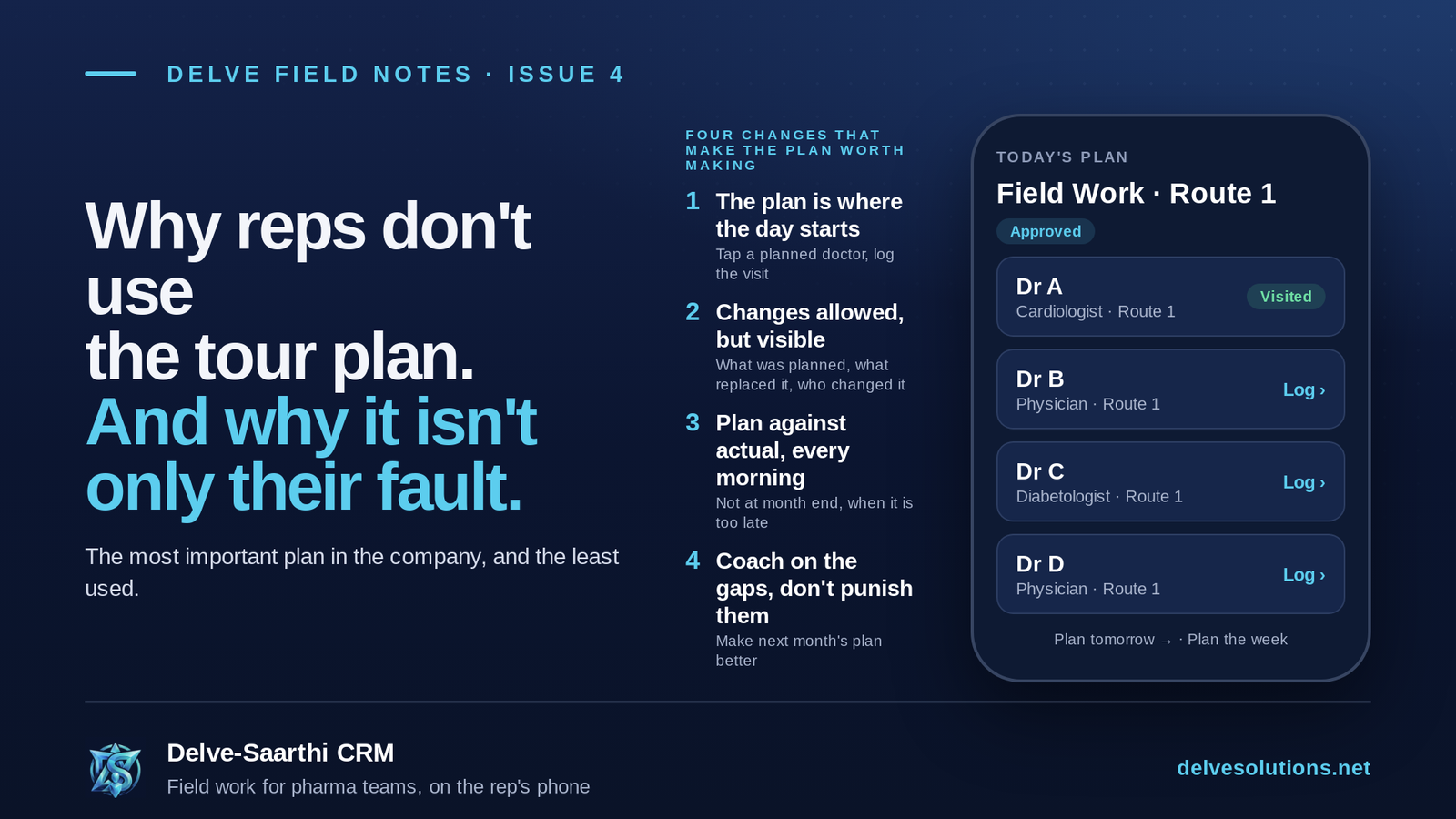
Ask any sales head what matters most in field work and the tour plan will be near the top. Ask how many reps actually work to it, and the answer is usually a laugh.
The plan is submitted around the 25th, approved in a hurry, and by the 3rd of the month the field has gone its own way. It is the most important plan in the company, and the least used.
It is easy to blame the rep. But look closely and the plan is being bent from both sides.
The manager bends it. He calls in the morning: "Come with me to the hospital today", "The stockist has a problem, go there first", "Head office wants these doctors covered this week". The rep agrees, of course. Nobody changes the plan.
The rep bends it too. A doctor is out of station, a clinic is closed, a market is closer to home. Sometimes the reason is genuine. Sometimes it is simply where he wanted to go. Nobody changes the plan either.
By the end of the month the plan says one thing, the calls say another, and nobody can tell which change was the field, which was the manager, and which was the rep's own wish. So nobody trusts the plan, and next month it is filled in only because someone asked for it.
Three causes, not one
1. The system.
The plan sits in one place and the call report in another, so the rep types the same doctors twice. The plan cannot be changed on the road, so the first surprise of the day makes it useless. If planning is extra work that the day's reporting does not use, it will be skipped.
2. The rep's habit.
An experienced rep knows his territory and decides the day in the morning. He sees the plan as a way to watch him, not to help him, so he writes it to satisfy the manager and then works the way he always has.
3. The manager's process.
This is the biggest one. If nobody compares the plan with what happened, the rep learns that the plan does not matter. If the only number that counts is the call average, the plan is just paperwork. And if the manager himself changes the day by a phone call, he has taught the team that the plan is a suggestion.
Four changes that make the plan worth making
1. The plan is where the day starts.
Today's planned doctors should be the first thing the rep sees, and logging a call should start from the plan, not from a fresh search. Then the plan saves work instead of adding it.
2. Changes are allowed, but they are visible.
The field changes every day, and a plan that cannot bend will be ignored. So let it bend, by the rep and by the manager, but keep the change on record: what was planned, what replaced it, and who changed it. A change that is written down is a fact; a change that is not is an argument.
3. Plan against actual, every morning.
Not at month end, when it is too late to correct anything. Yesterday's planned doctors, and how many were met, should be in front of the manager before he calls the team.
4. Coach on the gaps, don't punish them.
A doctor who is never available on the planned day is a planning problem. An area that is always "missed" is a coaching conversation. The point of comparing the plan with the field is to make next month's plan better, not to catch someone out.
A practical way to start, this month
You can begin tomorrow, with or without any software:
- Managers first: when you change a rep's day, change the plan too, or say so in writing.
- Agree what a "followed" day means, for example most of the planned doctors met, and tell the team.
- Look at yesterday's plan against actual every morning, for each rep, for five minutes.
- Ask "why" about a pattern, not about a single day.
- Use the gaps to write next month's plan with the rep, not for him.
How Delve-Saarthi helps
In Delve-Saarthi, the tour plan and the call report are one flow, on the phone the rep already carries.
- The rep's home screen shows today's plan; he taps a planned doctor and logs the visit from there.
- Planned doctors come first in the visit list, with a "Planned" tag. Any other doctor can still be called, through search.
- Today's plan can be changed on the spot. The change is saved at once, not approved, and the manager sees it beside the approved day.
- A change to a day of an approved month waits for the first-line manager, so the plan cannot quietly move.
- The rep plans tomorrow or the whole week from the phone, and applies a whole route in one go.
- Managers can receive a morning mail that shows whether yesterday's plan was followed (most planned doctors met; the company sets the level).
- Head office sees the tour plan of everyone below a manager, day by day, and an edit keeps the earlier version.
One question for every manager reading this: did you look at yesterday's plan against actual this morning?
Get the next issue by e-mail
One practical idea a week on running a pharma field force, Delve-Gurukul training and mentoring, and the Delve Partner Program. Free. Every mail has an unsubscribe link.
Subscribe freeAlready subscribed and want to stop? Use the unsubscribe link at the foot of any newsletter mail, or write to helpdesk@delvesolutions.in.