Delve newsletter · Issue 5 · Sales review
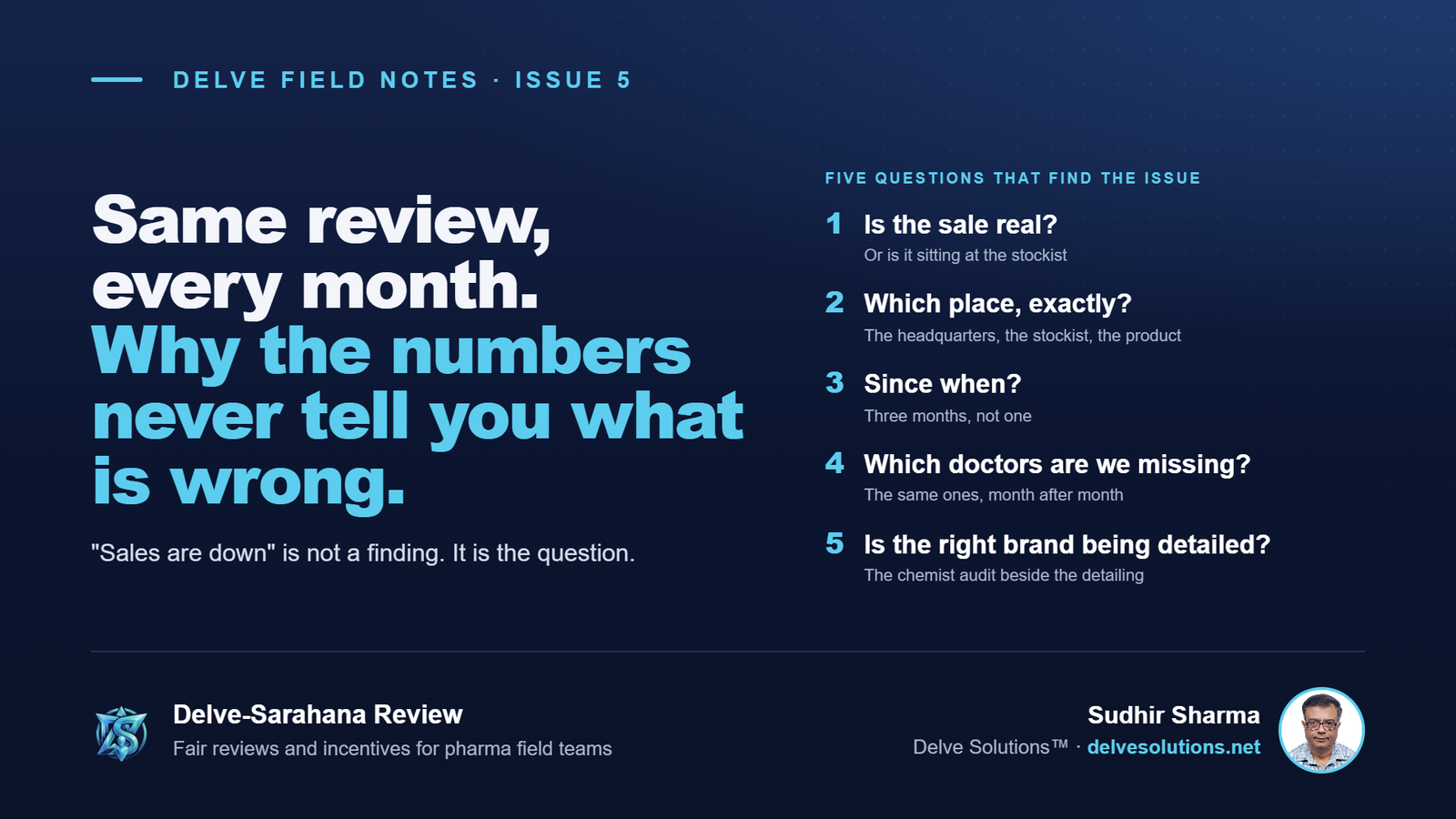
Same review, every month. Why the numbers never tell you what is wrong.
Sudhir Sharma, founder, Delve Solutions · 14 November 2026 · 6 minutes
Ask a medical representative what happens in the monthly review and he can recite it before the meeting starts.
Call average. Doctor coverage. Sales against target. A word about working harder. Next person.
Ask the manager, and the answer is not very different. He has run the same meeting for years. The slides change their month and nothing else.
That is why so many people in the field see no value in the review. Not because they fear it. Because it is the same every time, and it never tells them anything they did not already know.
Where the review gets stuck
The review is stuck at one point: the numbers are read out, but they are never joined to each other.
Look at what is usually on the table.
- Activity: calls made, doctors covered, days in the field.
- Result: primary sales against target.
They sit on two different slides, and the meeting moves from one to the other without asking how they are connected. So you get two conversations that go nowhere.
The rep with good calls and poor sales is told to improve his sales. He already knows that. Nobody tells him which doctors, which brand or which stockist.
The rep with poor calls and good sales is told to improve his calls. He smiles. His sales are fine, so he has just learnt that the call numbers do not matter.
In both cases the review has stated the result and stopped. "Sales are down eight per cent" is not a finding. It is the question.
Three reasons it stays stuck
1. The numbers are totals.
A total hides the place where the problem is. A territory at ninety per cent of target can be nine healthy stockists and one that has stopped buying, or it can be every stockist a little short. Those are two different problems with two different answers, and the total looks the same.
2. The review looks at one month.
A single month says how much. Only several months together say what is changing. A doctor missed once is a busy week. A doctor missed four months in a row is a decision somebody made, and never said aloud.
3. Activity and outcome are never put side by side.
Coverage is counted, and sales are counted, but nobody asks: of the doctors we met, which ones is the chemist actually selling for? Which brand did we talk about, and which brand moved? Until the two are on one page, the call report and the sales sheet are two separate stories.
So the manager falls back on the only advice a total allows: more calls, more effort. The rep hears it every month. That is the monotony.
Five questions that find the issue
A review earns its time when it moves from how much to where and why. These five questions do that.
1. Is the sale real, or is it sitting at the stockist?
Compare what the company billed with what the stockist sold onward. Primary running well ahead of secondary is not a good month; it is next month's problem, already booked.
2. Which place, exactly?
Not the region and not the team. Which headquarters, which stockist, which product. A review that cannot name the place cannot fix it.
3. Since when?
One bad month and three falling months need different conversations. Ask for the trend before the explanation.
4. Which doctors are we not meeting, month after month?
Coverage of ninety per cent says nothing about the ten per cent, and it is usually the same ten per cent every month.
5. Are we talking about the brand that is moving?
Put the chemist audit beside the detailing. A brand that the doctor's chemist sells and the rep never detailed is an open door. A brand detailed in every call that does not move at the chemist is a different lesson.
When the review answers these, the conversation changes by itself. It is no longer "your sales are down". It is "this stockist is carrying two months of stock, and these six doctors have not been met since August". That is something a person can act on.
A practical way to start, this cycle
You can begin with your next review, with or without any software:
- Bring one finding, not ten figures. Before the meeting, each manager writes one line per person: what is wrong, and where.
- Ask "where" before "why". Name the stockist, the doctor or the brand first.
- Look at three months, not one, for every figure you discuss.
- Put calls and sales on the same page, for the same doctors and the same brands.
- Skip what is fine. A review does not have to read every number. Time spent on a healthy territory is taken from a sick one.
How Delve-Sarahana Review helps
Sarahana means appreciation. A review can end there only if it has first found something true to talk about. Delve-Sarahana Review is built to point at the place, so the meeting can start from it.
- Every headquarters gets a health score from three things: whether secondary is keeping up with primary, the days of stock at the stockist, and achievement against target. You see which territory is unwell before you see who is responsible.
- Six alerts, and each one names its number. More than 60 days of stock cover. Less than 15 days. Liquidation below 0.60. Primary more than 15 per cent ahead of secondary. Achievement below 80 per cent with more than half the cycle gone. A product whose primary has fallen three months running. They are sorted by seriousness, then by the rupees at stake.
- Field work is read against your own mandates, for each role: calls, field days, coverage of core and other doctors, frequency, chemist audit.
- The doctor ledger gives every doctor one row across seven months, with the visits in each month. "Show missed only" leaves the doctors who are being skipped, which is the coaching list for the next joint working day.
- Chemist audit beside detailing, per doctor and brand, for the last three months. A brand that was audited but never detailed is marked.
- Where the data is missing, the screen says "Not measurable", never a low score. We could not measure this and this is bad must not look alike.
The system does not decide why. It shows where to look, with the number that sent you there. The why is still the manager's work, and it is the part of the review worth holding a meeting for.
Next Thursday: finding the issue is half the review. The other half is what happens after the meeting: who does what, by when, and what became of it at the next review.
One question for every manager reading this: in your last review, did anyone leave knowing something they did not know when they came in?
Get the next issue by e-mail
One practical idea a week on running a pharma field force, Delve-Gurukul training and mentoring, and the Delve Partner Program. Free. Every mail has an unsubscribe link.
Subscribe freeAlready subscribed and want to stop? Use the unsubscribe link at the foot of any newsletter mail, or write to helpdesk@delvesolutions.in.